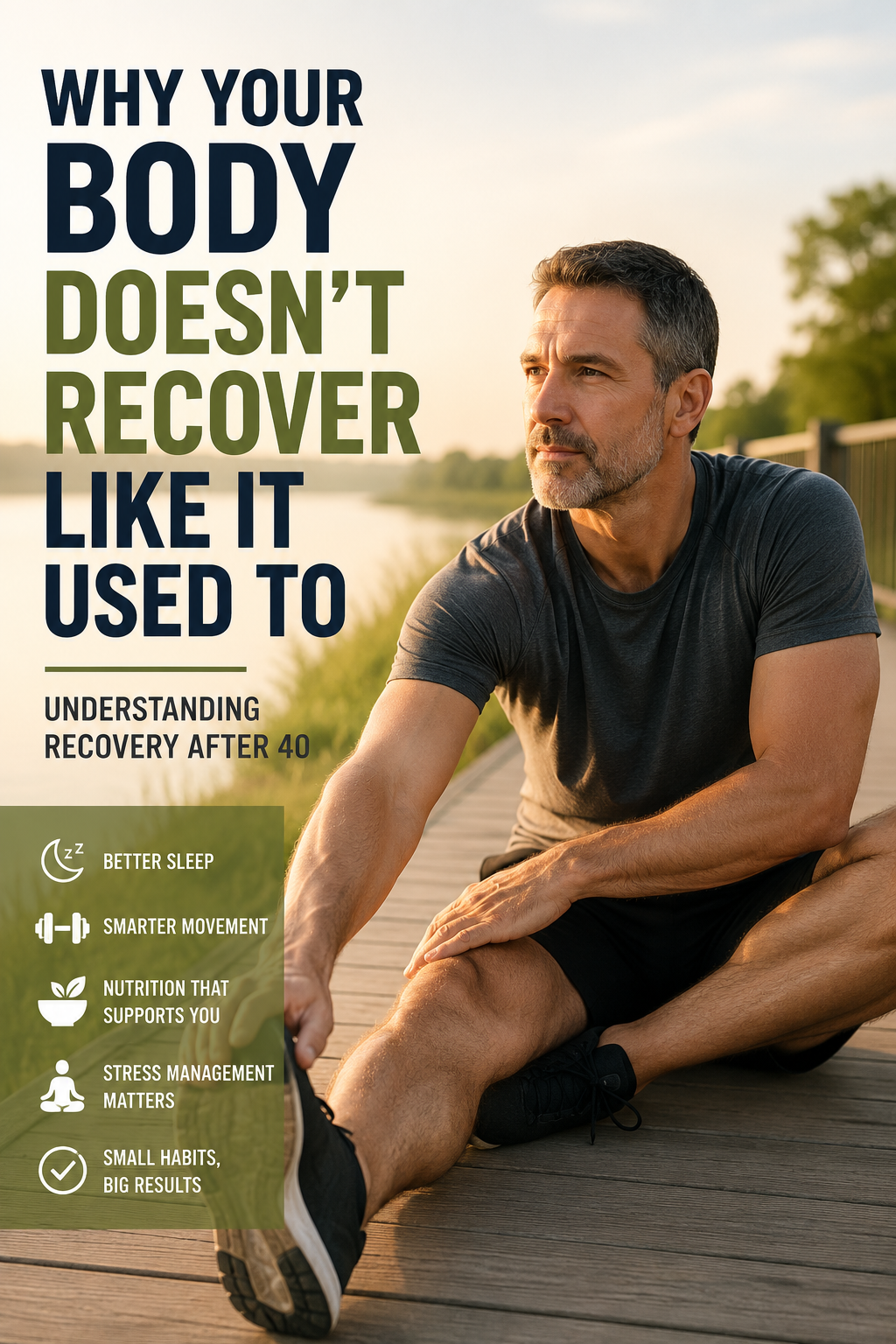
Getting older does not mean that your body suddenly stops working the way it should.
But many men notice something different after 40.
A workout that once required a day of recovery may now seem to require two. A late night can affect energy for several days. Muscle soreness may linger longer. Minor physical stress can feel more noticeable than it did in the past.
This does not necessarily mean that something is wrong.
In many cases, it reflects the interaction between aging, recovery capacity, sleep, physical activity, muscle mass, stress, and lifestyle.
Understanding these changes is the first step toward responding to them appropriately.
Recovery Is More Than Muscle Soreness
When people talk about recovery, they often mean recovering from exercise.
But recovery is much broader.
Your body is constantly recovering from different forms of physiological stress:
- physical training;
- work;
- insufficient sleep;
- psychological stress;
- illness;
- nutritional deficits;
- long periods of inactivity;
- everyday physical demands.
Recovery therefore involves restoring the capacity to function after stress.
That includes muscles, the nervous system, energy regulation, cardiovascular function, sleep and psychological well-being.
This is why a person can feel “recovered” from muscle soreness but still feel mentally exhausted.
Recovery is not one process.
It is a collection of processes happening simultaneously.
Why Recovery Can Feel Different After 40
There is no single switch that flips at age 40.
The changes are gradual and highly individual.
However, aging is associated with changes in several physiological systems that can influence how the body responds to stress and physical activity.
One important factor is the gradual loss of muscle mass and strength that can occur with aging, particularly when physical activity is insufficient.
This matters because muscle is not simply tissue used for exercise.
It contributes to strength, mobility, glucose regulation and physical independence.
Maintaining muscle therefore becomes increasingly important as the years pass.
Recovery Capacity Depends on More Than Age
Age is only one variable.
Two men of the same age can have very different recovery experiences.
Consider two 45-year-old men.
One:
- sleeps consistently;
- strength trains;
- remains physically active;
- maintains a healthy body composition;
- eats adequately;
- manages stress reasonably well.
The other:
- sleeps irregularly;
- spends most of the day sitting;
- rarely exercises;
- carries excess abdominal fat;
- frequently eats poorly;
- experiences chronic stress.
Their chronological ages are identical.
Their physiological environments are not.
This is one reason it is misleading to treat “being over 40” as a diagnosis.
Age influences recovery, but lifestyle influences the environment in which aging occurs.
Muscle Recovery and Muscle Aging
One of the most important changes to understand is the relationship between aging and muscle.
With increasing age, maintaining muscle mass and strength generally requires more deliberate attention.
This does not mean that older adults cannot gain muscle.
They can.
But the importance of consistent resistance training increases because inactivity can accelerate the loss of physical capacity.
Strength training therefore becomes more than a tool for appearance.
It becomes part of maintaining functional reserve.
That reserve matters when you are 50, 60, 70 and beyond.
Sleep and Recovery
Sleep is another major component of recovery.
During sleep, the body coordinates multiple physiological processes involved in restoration and regulation.
Poor sleep can affect:
- energy;
- mood;
- cognitive performance;
- exercise performance;
- appetite regulation;
- perceived recovery.
This creates an important distinction.
Someone may believe:
“My body isn’t recovering anymore.”
But the underlying problem may partly be:
“My recovery environment has changed.”
Working longer hours, sleeping less, experiencing more stress and becoming less physically active can all accumulate over time.
The problem may not be age alone.
The Cardiovascular Dimension
Recovery also depends on cardiovascular health.
The cardiovascular system delivers oxygen and nutrients throughout the body and supports physical activity.
As men age, cardiovascular risk factors become increasingly important to monitor.
Blood pressure, cholesterol, glucose regulation, physical activity and body composition all matter.
This is another reason why recovery should not be treated purely as a muscle problem.
A man may be interested in recovering faster from his workouts while ignoring the cardiovascular system that supports those workouts.
A broader approach makes more sense.
Metabolic Health and Recovery
Metabolic health is also connected to physical function.
Excess visceral and abdominal fat, impaired glucose regulation and other metabolic problems can affect overall health and physical capacity.
This does not mean that every man with abdominal fat has poor recovery.
It means that body composition and metabolic health belong in the larger picture.
The goal should therefore not necessarily be to achieve the lowest possible body weight.
For many men, a more useful objective is:
reduce excess abdominal fat while preserving muscle and strength.
That is a fundamentally different goal from simply becoming lighter.
Stress Changes the Recovery Equation
Recovery isn’t only physical.
Psychological stress also consumes resources.
Work pressure, relationship problems, financial concerns, lack of sleep and constant digital stimulation can make it harder to feel recovered.
This does not mean that stress “destroys testosterone” or that every stressful day causes hormonal dysfunction.
The human body is more complicated than that.
But chronic stress can influence sleep, behavior, physical activity and overall well-being.
Those effects can indirectly make recovery more difficult.
Why the Same Workout Can Feel Different
Imagine a man who trained hard at 25.
He slept eight hours.
He had fewer work responsibilities.
He recovered and trained again.
Twenty years later, the same man may:
- sleep six hours;
- work longer hours;
- spend more time sitting;
- have gained abdominal fat;
- exercise less consistently;
- experience greater psychological stress.
The workout itself may not have changed.
The recovery environment has.
This is one of the most important ideas to understand about recovery after 40.
Sometimes the answer isn’t necessarily to stop training.
It may be to improve the conditions surrounding the training.
Recovery Reserve
A useful way to think about this is the concept of recovery reserve.
Recovery reserve is not a medical measurement.
It is a practical way of thinking about how much capacity a person has to absorb stress and return to normal function.
Sleep contributes to that reserve.
Muscle contributes.
Cardiovascular fitness contributes.
Nutrition contributes.
Mental recovery contributes.
Healthy body composition contributes.
When several of these are working well, the person may tolerate physical and psychological stress better.
When several deteriorate simultaneously, even relatively small stresses can feel much harder.
Why Recovery Is Part of Healthy Aging
Healthy aging isn’t simply about living longer.
It is also about maintaining the ability to function.
Can you:
- climb stairs?
- carry objects?
- walk comfortably?
- get up from the floor?
- train?
- work?
- participate in activities you enjoy?
These abilities depend heavily on physical capacity.
Recovery is therefore part of preserving that capacity.
The objective isn’t to recover exactly like a 25-year-old forever.
The objective is to maintain as much functional capacity as possible as you age.
What About Hormones?
Hormonal changes are part of aging, including changes in testosterone.
But this does not mean that every decline in recovery is caused by testosterone.
A persistent change in energy, libido, sexual function or physical performance may justify medical evaluation.
However, the appropriate response is investigation—not automatically assuming that hormones are the explanation.
This distinction is important because symptoms such as fatigue and reduced performance can have many possible causes.
The Bigger Picture
Recovery after 40 is best understood as an interaction between:
Age
Sleep
Muscle
Physical activity
Nutrition
Metabolic health
Cardiovascular health
Stress
Individual circumstances
This is why there is rarely a single “recovery hack” that solves everything.
The body doesn’t operate through isolated hacks.
It operates through interconnected systems.
Final Thoughts
If recovery feels different after 40, that doesn’t automatically mean your body is failing.
It may mean that the relationship between stress and recovery has changed.
Some physiological changes are part of aging.
Others are strongly influenced by lifestyle.
And many are modifiable.
Understanding that distinction is important.
Because once you understand why recovery can change, the next question becomes much more practical:
What can you actually do about it?
For that, see:
Why Recovery Gets Slower After 40 — And What Daily Habits Can Influence
That article focuses on the practical side: sleep, movement, strength training, nutrition, stress management and recovery habits that can be incorporated into everyday life.
Editorial perspective
This article is educational and does not diagnose or treat any medical condition. Persistent or unexplained fatigue, weakness, changes in exercise tolerance, or significant changes in sexual function should be discussed with a qualified healthcare professional.
📎 Suggested Next Reads
- Why Your Sleep Is Worse Than You Think — And How to Fix It
- Improve Energy Naturally: Lifestyle Factors That Matter
- Low Testosterone in Men: Causes, Symptoms, and Considerations
Disclosure
This article is intended for informational and educational purposes only. Some readers may choose to explore additional educational resources or products discussed elsewhere on our website. This does not influence our editorial independence.
Transparency & Affiliate Disclosure
Some pages on Last Pieces may contain affiliate links. If readers choose to visit external websites through these links, we may earn a commission at no additional cost.
Last Pieces does not provide medical advice, diagnosis, or treatment recommendations. Readers should consult qualified healthcare professionals regarding personal health concerns.