“Flat-style illustration of a person working in a calm, focused environment.”
Modern productivity isn’t really about doing more — it’s about doing what matters, consistently, without burning yourself out. Yet most people struggle with productivity not because they lack discipline, but because they follow systems that were never designed for real life.
Below is a clear breakdown of why productivity systems fail, what science and real-world experience show actually works, and simple steps you can apply today.
1. The Real Problem Isn’t Laziness — It’s Cognitive Overload
Most people think they’re “unproductive” because they’re unmotivated. In reality, the average person processes more information in a single day than people in the 1970s processed in a week.
Your brain isn’t built for:
- fragmented attention
- constant notifications
- switching tasks every 3–5 minutes
- endless micro-decisions
This overload creates decision fatigue, which makes even simple tasks feel heavier.
What works instead:
Reduce cognitive load by limiting choices and creating repeatable routines. When the basics are automated, you free up attention for real work.
Try:
- a fixed morning routine
- planning your day the night before
- batching similar tasks
- using one single place to store all to-dos (not 5 apps)
Your productivity rises when your brain stops wasting energy on chaos.
2. Productivity Fails When You Set Unrealistic Daily Goals
Most people overestimate what they can do in a day, but underestimate what they can do in a year.
A common mistake:
“I’ll finish 10 tasks today.”
What actually happens:
- you finish 2
- feel frustrated
- sabotage tomorrow’s motivation
The result: a pattern of self-blame that kills long-term consistency.
What works instead:
Define 3 high-impact tasks per day (MITs — Most Important Tasks). When everything feels important, nothing truly is.
A simple rule:
If completing this task would make the day feel productive by itself, it’s an MIT.
Examples:
- Writing a full page of your project
- Finishing an important email
- Researching one key topic
- Cleaning your inbox only if it’s necessary for progress
Fewer tasks → More focus → Higher completion rate.
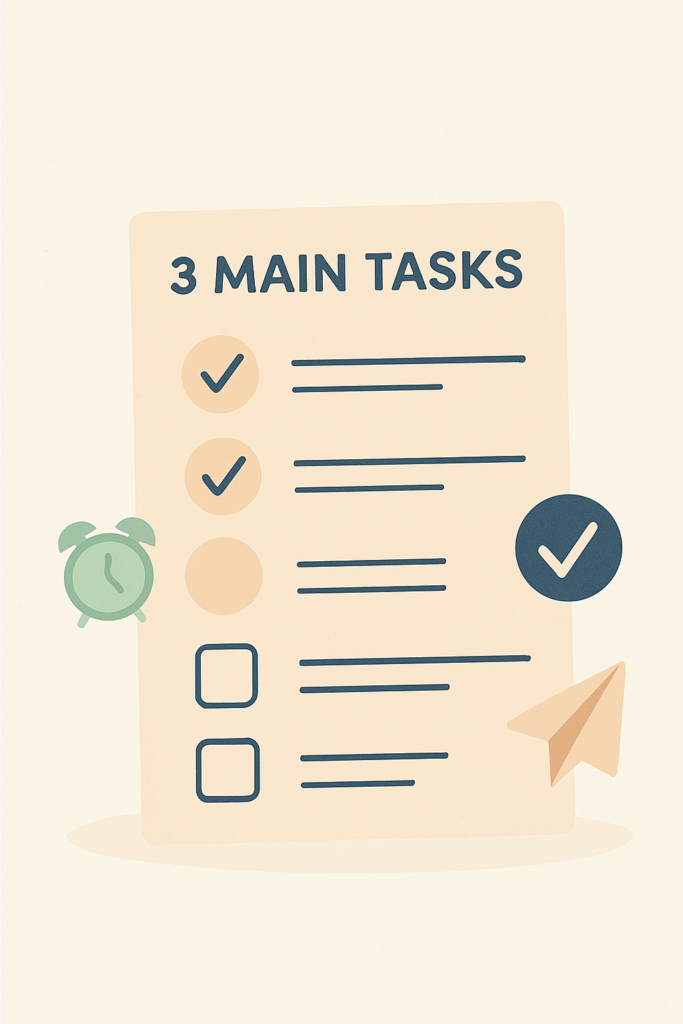
“Minimal planner showing three main tasks to represent realistic productivity goals.”
3. People Copy Productivity Systems That Don’t Fit Their Life
You don’t need someone else’s morning routine.
You don’t need a billionaire’s schedule.
You don’t need a 5AM workout unless it fits your energy cycles.
Most productivity failures come from copying, not customizing.
What works instead:
A system that matches your:
- energy patterns
- work rhythm
- responsibilities
- family schedule
- natural strengths
If your high-energy zone is at night, stop forcing yourself to do deep work at 7AM. If you’re a morning person, don’t schedule demanding tasks late.
Productivity is personal — not universal.
4. Multitasking Is the Silent Killer of Focus
People still believe they can multitask, even though decades of research say the opposite.
You don’t multitask —
you task-switch.
Every switch costs:
- lost time
- lost concentration
- lost working memory
- increased stress
One study shows switching tasks can reduce productivity by up to 40%.
What works instead: Single-tasking.
Try this:
- Pick one task.
- Close everything else.
- Work in focused blocks (25–50 minutes).
- Rest 5–10 minutes.
This simple method can double output in a single week.
5. You Never Learned to Protect Your Attention
You protect your phone with a password.
You protect your home with a lock.
But your attention — your most valuable asset — is usually unprotected.
Apps, notifications, and social platforms compete aggressively for your time, and they’re winning.
What works instead:
Create “attention boundaries.”
Examples:
- Turn off all non-essential notifications.
- Keep your phone in another room during deep work.
- Use browser blockers during focus time.
- Check messages at set intervals, not randomly.
You don’t need perfect discipline — you need fewer traps stealing your focus.
6. Consistency Beats Motivation Every Time
Motivation is unstable.
Habits are not.
You won’t feel motivated to do deep work every day — but if your schedule includes natural anchors (ex.: same time, same place), the action becomes automatic.
What works instead:
Build tiny, repeatable rituals:
- 1-minute planning
- 5-minute workspace reset
- 10-minute warm-up before starting a project
- same playlist or environment
These micro-routines signal your brain:
“It’s time to work.”
Small habits, repeated daily, create massive long-term productivity.
7. Energy Management > Time Management
Traditional productivity advice focuses on hours.
But real productivity depends on energy cycles, not clocks.
Ask yourself:
- When do I feel sharpest?
- When do I crash?
- What drains me fastest?
- Which tasks energize me?
You may discover:
- your peak thinking happens early
- your routine tasks fit better after lunch
- your creative spark appears at night
Productivity skyrockets when you match tasks with your natural energy curve.
8. The Simplest Rule: Make Work Feel Lighter
If your system feels heavy, you won’t stick with it.
Productivity improves when you remove friction:
- work at a clean desk
- start with 2 minutes (momentum trick)
- break tasks into micro-steps
- automate repetitive actions
- create checklists for recurring processes
When work feels “lighter,” procrastination loses power.
9. Practical Steps You Can Start Today
Here’s a simple roadmap you can implement right now:
1. Identify your top 3 high-impact tasks for tomorrow.
Write them tonight.
2. Block 1–2 hours for deep work.
One session is enough to change your week.
3. Remove one productivity killer.
Notifications, clutter, multitasking — pick one.
4. Use a single to-do capture system.
Not your head.
5. Track results weekly, not daily.
Progress builds slowly and compounds.
“Flat-style illustration symbolizing energy management and sustainable productivity.”
10. Final Thoughts
You are not unproductive — you’re overloaded with systems that were never built for your reality. Instead of forcing the latest trend, build a structure around your energy, your schedule, and your priorities.
Real productivity isn’t about grinding harder.
It’s about removing friction, protecting your attention, and doing the right things consistently.
Small changes, repeated daily, can reshape your entire year.